Jewish Painter

Sep 1, 2026

Newish and Jewish from Europe:
Refugees, Survivors and the Spread of Modernism
Presentation by Samuel D. Gruber

2026-09-01T07:13:25-04:00September 1st, 2026|, |Comments Off on Newish and Jewish from Europe:
Refugees, Survivors and the Spread of Modernism
Presentation by Samuel D. Gruber

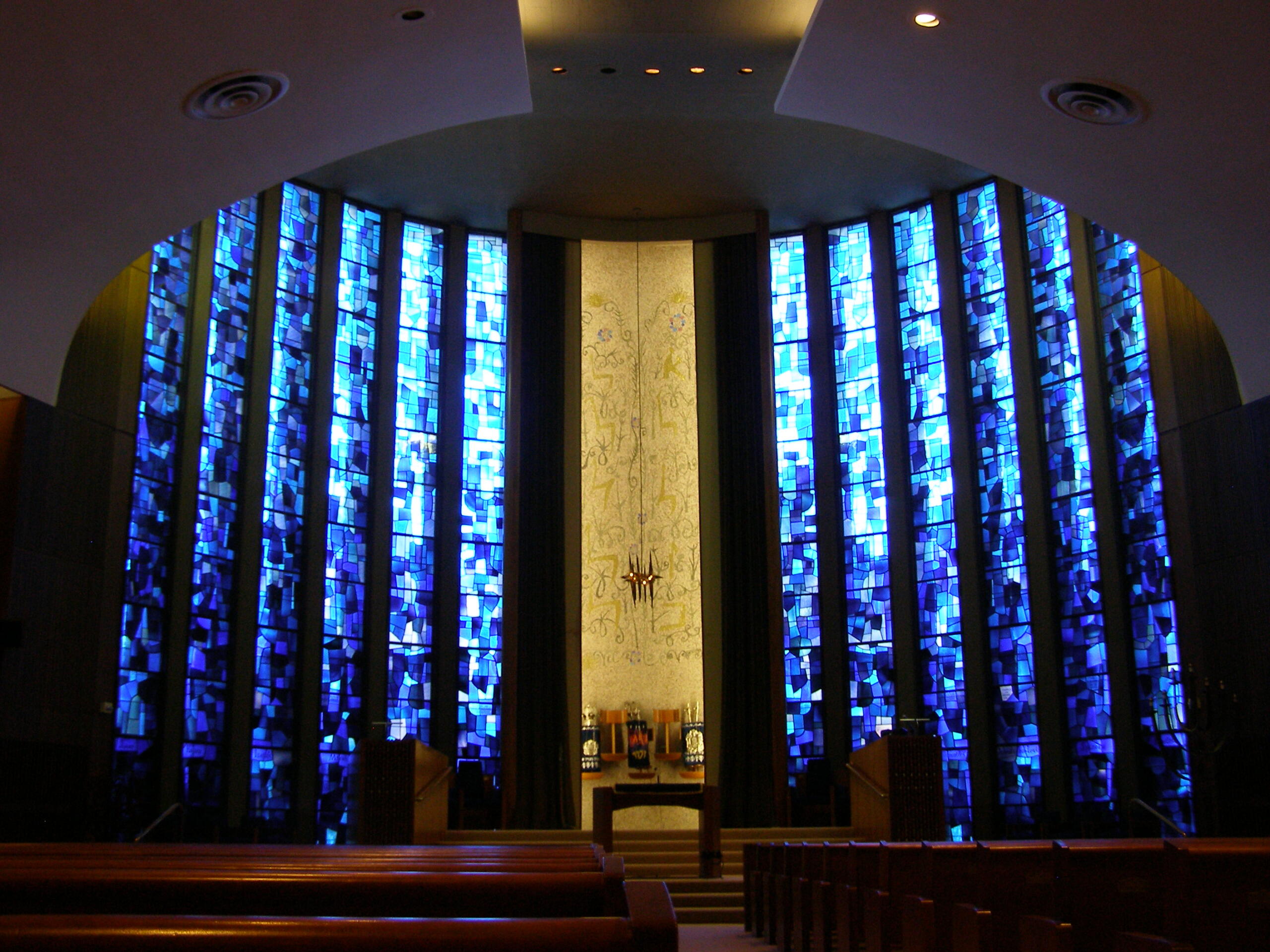
The architecture of the American Jewish community was transformed following World War II by émigré and refugee architects engaged to design synagogues and Jewish Community Centers. Eric Mendelsohn’s synagogues for St. Louis, Cleveland and elsewhere are well known but the work of Fritz Nathan, Mendelsohn’s German-Jewish contemporary, is virtually forgotten. Image above: Hamden, CT, Mishkan Israel sanctuary, photo S. Gruber, 2011. Architects: Fritz Nathan and Bertram Bassuk, Ark: Ben Shahn, Stained Glass: Robert Pinart and Jean-Jacques Duval REGISTER HERE Erich Mendelsohn, sketch for Congregation Bnai Amoona, St Louis, MO Erich Mendelsohn, Model for Congregation Bnai Amoona, St Louis, MO Nathan arrived in the United States [...]

Sep 1, 2026

Reconciling Identities:
Marcel Janco and the Romanian Avant-Garde in the Interwar Years
Presentation by Amelia Miholca
followed by a conversation with Nicola Baird, PhD, London (UK)

2026-09-16T14:42:28-04:00September 1st, 2026|, , |Comments Off on Reconciling Identities:
Marcel Janco and the Romanian Avant-Garde in the Interwar Years
Presentation by Amelia Miholca
followed by a conversation with Nicola Baird, PhD, London (UK)

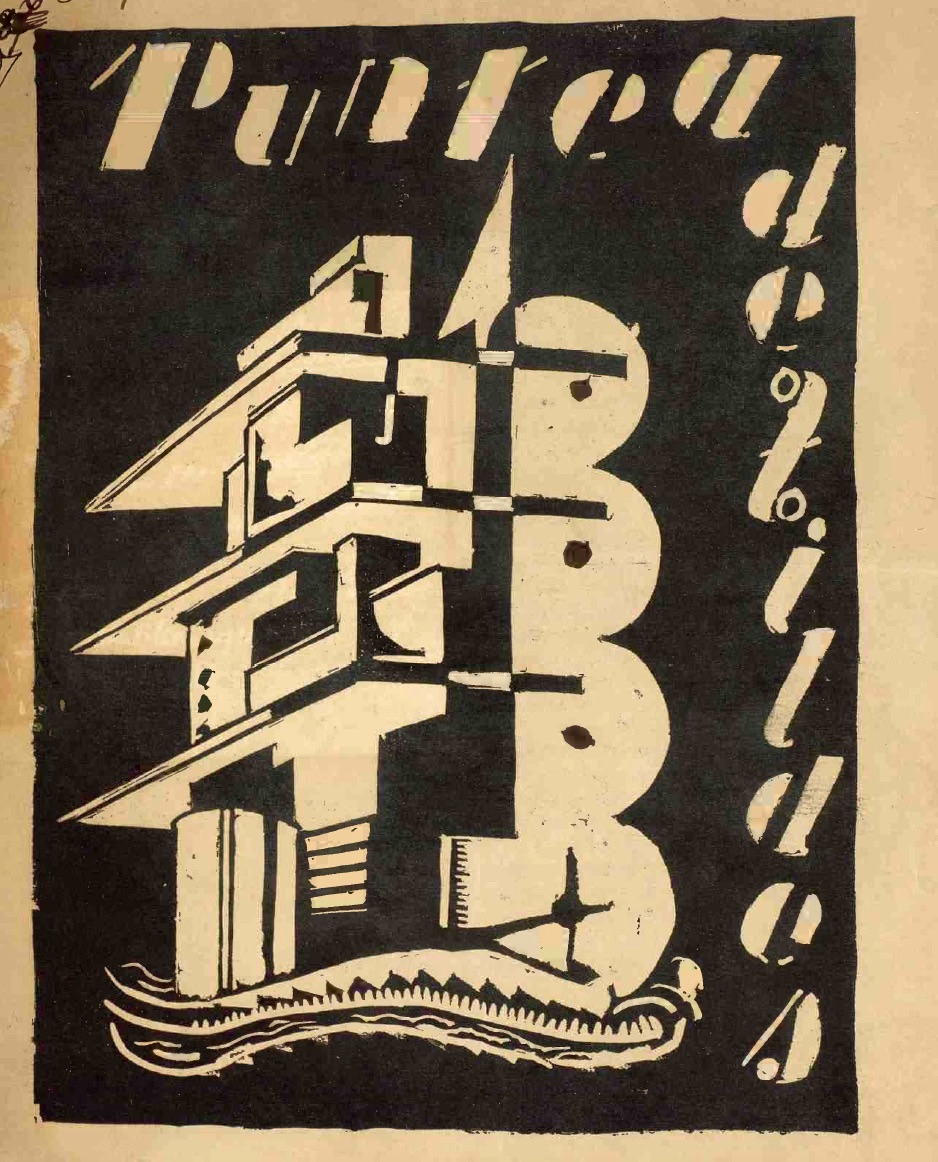
In her presentation, Dr. Miholca will spotlight the artistic and historical significance of Marcel Janco and the Romanian avant-garde group during a period of tremendous creative experimentation and productivity, when artists and writers merged their Jewish identity with the international identity they sought to foster through their network of dadaist and constructivist magazines. Janco, alongside other Romanian-Jewish artists like M. H. Maxy, Victor Brauner, Mattis Teutsch, and Benjamin Fondane, wished to capitalize on the Dada movement initiated by Janco and Tristan Tzara—alongside Hugo Ball, in Zurich, 1916—with their own avant-garde movement in Bucharest that mainly emerged through magazines such as Contimporanul (1922-1932), 75HP (1924) and Integral (1925-1928). The presentation will be followed by a conversation with Nicola Baird, PhD. [...]

Aug 12, 2025

The Three Exiles of the German-born artist Samson Schames (1898-1967)
Conversation with Annika Friedman (Germany), Rachel Dickson, PhD (UK) and Ori Z Soltes, PhD (USA)

2025-09-26T07:49:38-04:00August 12th, 2025|, , |Comments Off on The Three Exiles of the German-born artist Samson Schames (1898-1967)
Conversation with Annika Friedman (Germany), Rachel Dickson, PhD (UK) and Ori Z Soltes, PhD (USA)

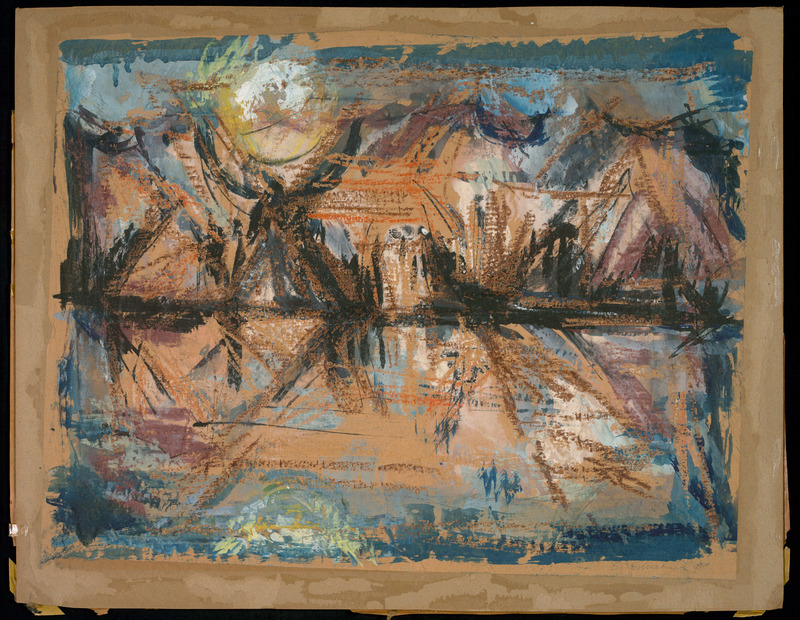
In this virtual event, a transatlantic panel discusses the artist Samson Schames. Annika Friedman (Germany) elaborates on the artist’s beginnings in Frankfurt, Rachel Dickson, PhD (UK) gives an insight into the work he made in British exile, and Ori Z. Soltes, PhD (USA) speaks about the work he created in his new home, New York. The presentations are followed by a moderated discussion and Q&A. Image above: Samson Schames, Granite Quarry No. 1, 1958. Casein on board, 20.75 in. x 26.25 in. Leo Baeck Institute New York 2007.97 Samson Schames was a German-Jewish artist born in 1898 in Frankfurt am Main, Germany, into a prominent Jewish family involved in the textile business. He initially trained [...]

Aug 11, 2025

Samson Schames (1898-1967): Family and Friends
Conversation with Natalie Green Giles, James McCaffrey and Charlie Scheidt.
Moderated by William Weitzer

2025-09-26T07:54:22-04:00August 11th, 2025|, , |Comments Off on Samson Schames (1898-1967): Family and Friends
Conversation with Natalie Green Giles, James McCaffrey and Charlie Scheidt.
Moderated by William Weitzer

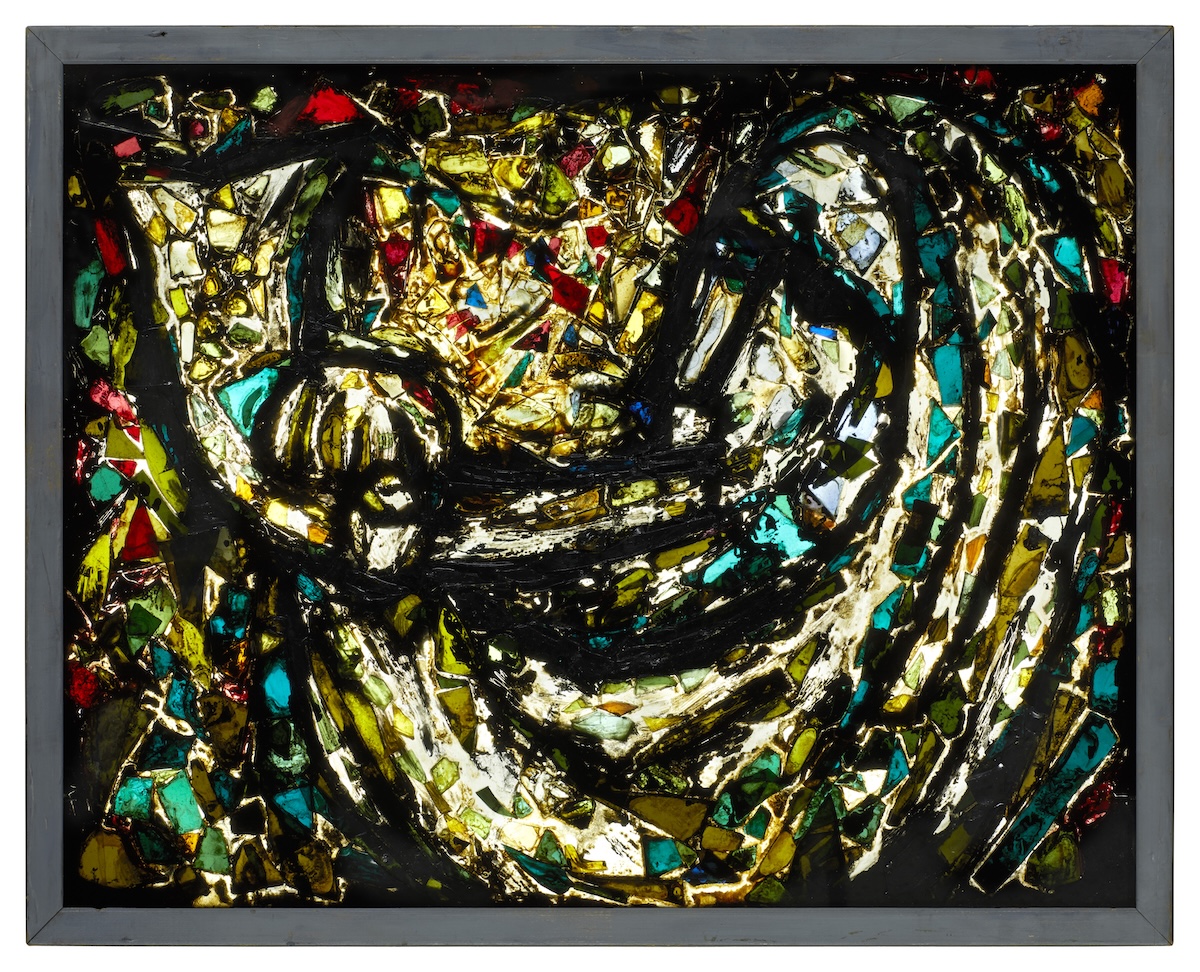
In this virtual event, a distinguished panel comprising family members, friends, and their descendants from New York share memories of the German-born artist Samson Schames (1898-1967). His work, which blends modernist aesthetics with spiritual and historical depth, is recognized for its innovative technique and poignant reflections on exile, memory, and identity. Born in Frankfurt am Main, Germany, he fled Nazi persecution to England in 1939 and later emigrated to the United States with his future wife, Edith, in 1948 and 1947.  Image above: Samson Schames, Blowing the Shofar, c. 1956. Shards of glass, polychrome, layered in relief, 25.4 x 29.7 in. (64.5 x 75.5 cm). Jewish Museum Frankfurt A short film created [...]

Aug 4, 2025

Theodore Fried (1902-1980): In Hiding and Beyond
Presentation by Sofia Thornblad, Tulsa (OK)

2025-09-03T14:31:57-04:00August 4th, 2025|, , |Comments Off on Theodore Fried (1902-1980): In Hiding and Beyond
Presentation by Sofia Thornblad, Tulsa (OK)

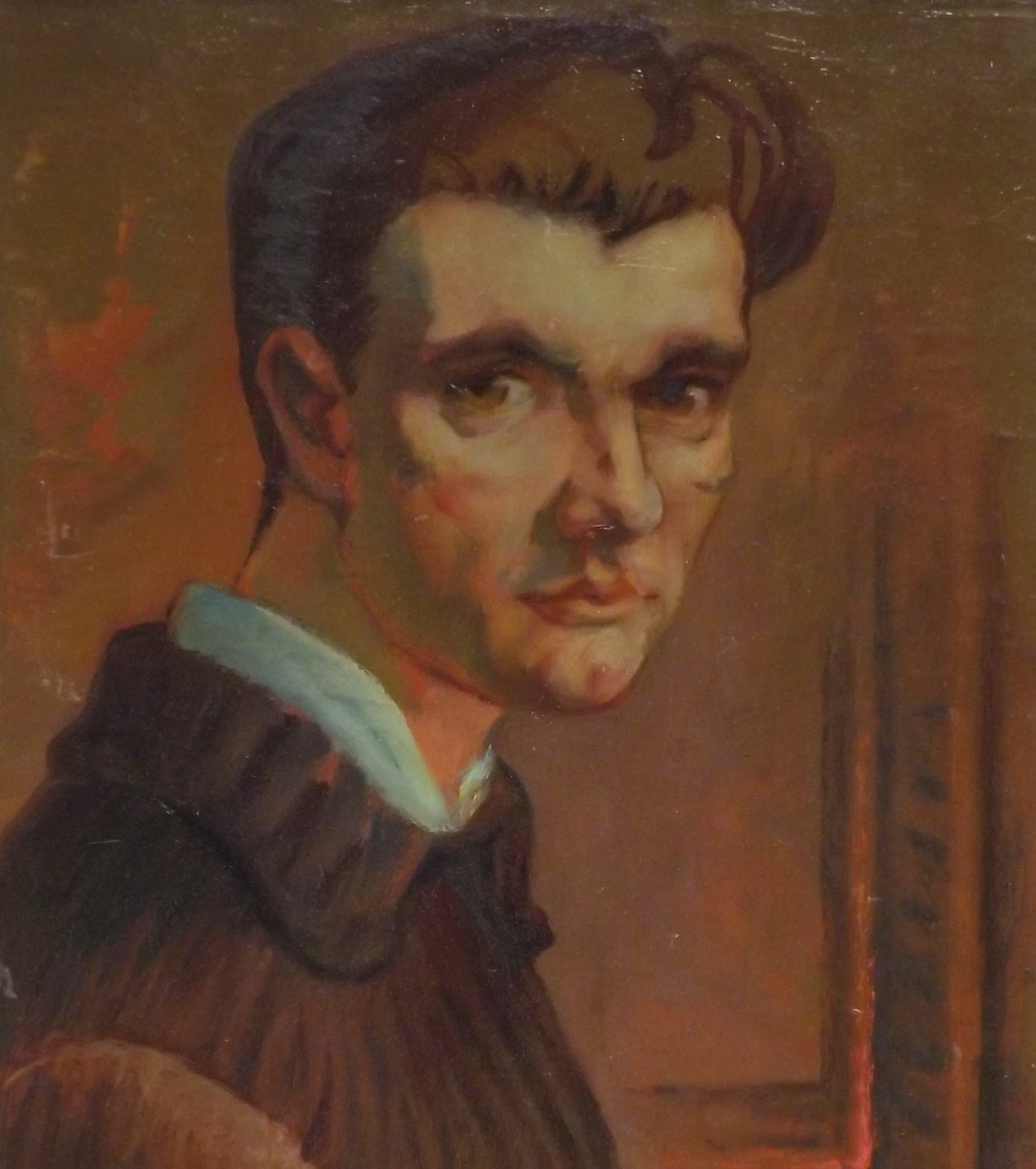
This presentation explores the historical background and creative works of Hungarian-born Jewish artist Theodore Fried (1902-1980). He was educated at the Budapest Academy of Fine Arts and moved to Vienna in 1924 and to Paris in 1925. He met and married his first wife Anna and his son Christopher was born in 1928. That same year, the artist had his first one-man show, and was included in important shows in Vienna, Prague, Berlin, and Paris. Image above: Detail of Theodore Fried, Self Portrait, 1938. Oil on canvas. Sherwin Miller Museum of Jewish Art, Tulsa (OK) When the Nazis came to power in 1933, Fried’s work was labeled as “degenerate”. He fled with [...]

May 16, 2025

Victor Brauner’s Departures and Returns
Presentation by Irina Cărăbaș, Bucharest (Romania)
followed by a conversation with Nicola Baird, PhD, London (UK)

2025-06-12T04:02:06-04:00May 16th, 2025|, , |Comments Off on Victor Brauner’s Departures and Returns
Presentation by Irina Cărăbaș, Bucharest (Romania)
followed by a conversation with Nicola Baird, PhD, London (UK)

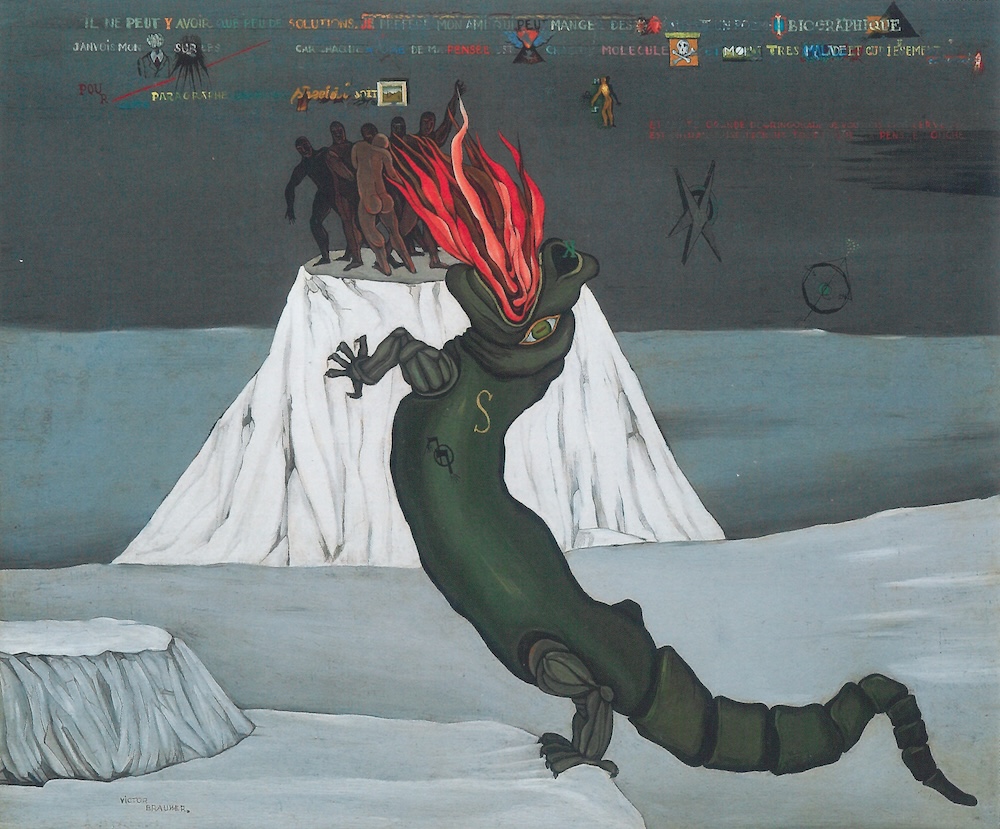
This presentation by Irina Cărăbaș from the National University of Arts in Bucharest focusses on several key artistic and political contexts relevant to Brauner’s work and biography, as well as his reception in Romania. It is followed by a conversation with Nicola Baird, PhD. Introductory remarks by Sorina Neagu, Director of DOR – Romanian Diaspora. Image above: Victor Brauner, Composition, not dated, oil on canvas, 53,5 x 64,5 cm, National Museum of Arts of Romania, Bucharest (INV. 73973/8502) © 2025 Artists Rights Society (ARS), New York / ADAGP, Paris Born in Piatra Neamț, Romania into a Jewish family, Victor Brauner (1903-1966) took part in shaping several avant-garde groups in Bucharest since his early twenties. [...]

Mar 24, 2025

Léo Maillet (1902-1990): The Broken Mirror
Presentation by Erik Riedel, Frankfurt am Main (Germany)

2025-04-09T14:22:41-04:00March 24th, 2025|, , |Comments Off on Léo Maillet (1902-1990): The Broken Mirror
Presentation by Erik Riedel, Frankfurt am Main (Germany)

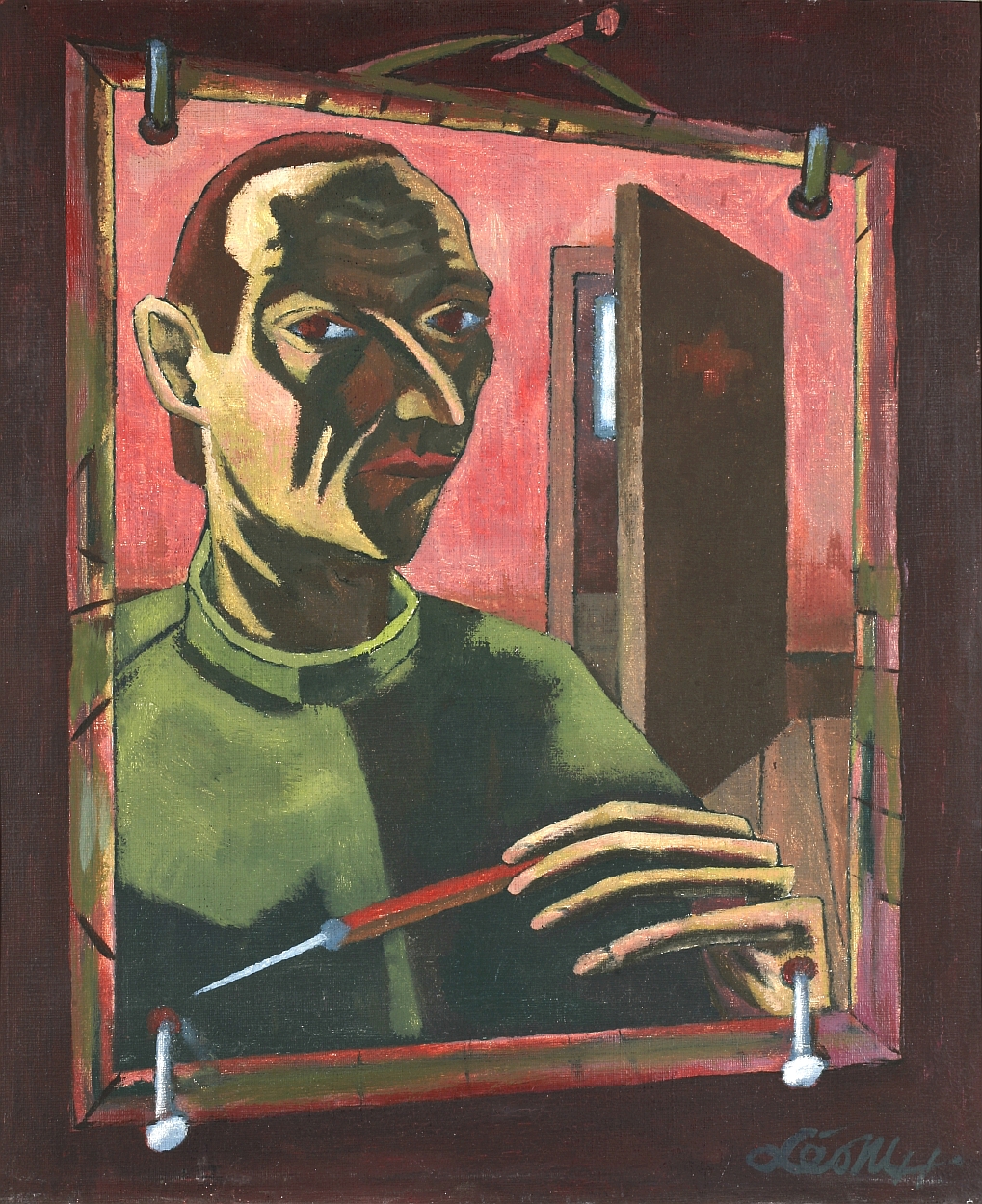
Curator Erik Riedel presents the work of the painter and graphic artist Léo Maillet, who changed his original name Leopold Mayer in exile, reflecting the numerous fractures in his biography. Image above: Léo Maillet, Le Graveur (Self-Portrait), 1944. Oil on cardboard. Permanent loan by the Adolf und Luisa Haeuser-Stiftung für Kunst und Kulturpflege. © estate of Léo Maillet: Daniel Maillet and Nikolaus Mayer After his dramatic escape from a deportation train bound for Auschwitz, Maillet lived in the French Cévennes under a false identity from 1942 onwards. He painted and drew with the simplest of materials. Some years later, he took up the works he had created during his flight and persecution and transformed them [...]

May 25, 2022

The Shape and Color of Survival.
Samuel Bak (born Vilnius, Lithuania, 1933)
Lecture by Ori Z Soltes, PhD

2022-12-07T18:53:36-05:00May 25th, 2022|, , |Comments Off on The Shape and Color of Survival.
Samuel Bak (born Vilnius, Lithuania, 1933)
Lecture by Ori Z Soltes, PhD

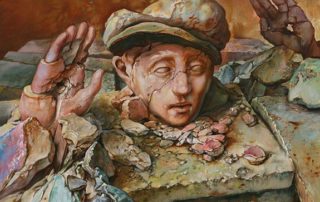
Image above: Samuel Bak, Warsaw Excavation, 2007. Oil on canvas, 16 x 20 in. Image Courtesy Pucker Gallery © Samuel Bak Samuel Bak was 6 years old when the Nazis began ending his childhood, as the war that they engendered would soon extend to his native Vilnius. The number “6” became an important element in his art, since it is also the number of the Commandment with which God enjoins us not to commit murder, for which the Holocaust represented such a profound abrogation. His father smuggled him out of the ghetto in the sack that he was still permitted to use to gather firewood—and was subsequently murdered by the regime. By then Bak himself had already [...]

Mar 23, 2018

FRITZ ASCHER SOCIETY Newsletter #19, March 2018

2018-12-04T11:47:15-05:00March 23rd, 2018|Newsletter|Comments Off on FRITZ ASCHER SOCIETY Newsletter #19, March 2018

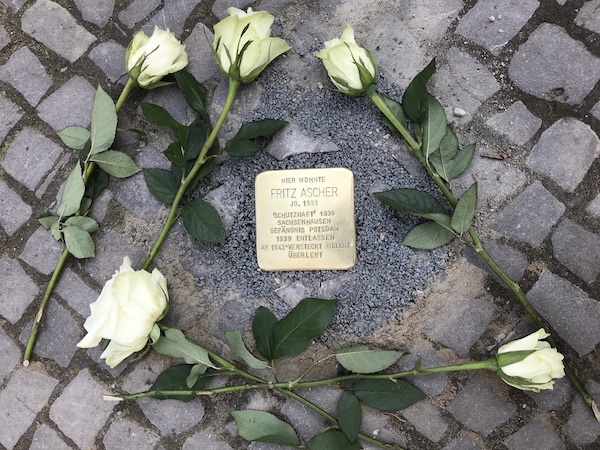
Dear Friends, I was touched by how many neighbors and friends from near and far came out into the chilly but sunny winter weather on February 21 to celebrate Fritz Ascher and recognize his persecution by the National Socialists by laying a “Stolperstein” (stumbling stone) at Niklasstraße 21/23 in Berlin-Zehlendorf, where his family lived from 1909. Thank you to the anonymous donor for making this event possible, to Dirk Jordan (AG Stolpersteine), Michael Rohrmann (Projekt Stolpersteine) and Wolfgang Ellerbrock for organizing it, to Cornelie von Bismarck for creating a beautiful context, and to Sabine Witt from Museum Charlottenburg-Wilmersdorf in Berlin and Jutta Götzmann from Potsdam Museum for supporting it. A special thank you to the students from Potsdam for reciting [...]

Dec 21, 2017

FRITZ ASCHER SOCIETY Newsletter #16, October 2017

2018-12-04T12:15:18-05:00December 21st, 2017|Newsletter|Comments Off on FRITZ ASCHER SOCIETY Newsletter #16, October 2017

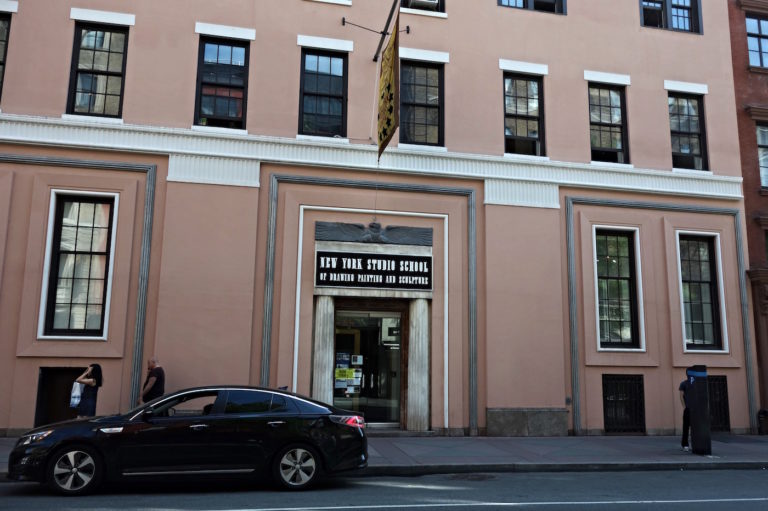
Dear Friends, Today I am excited to share with you some photos of last week’s opening of “Beauteous Strivings: Fritz Ascher, Works on Paper”, which is on view at the New York Studio School daily 10:00am-6:00pm until December 3 (website link). In this exhibition, “powerful emotions seem to lurk just beneath the apparent directness and economy of the tree and flower paintings” of the 1950s and 1960s, observes curator Karen Wilkin in the catalogue that accompanies the exhibition. She continues: “A sense of near-obsession, of ferocious concentration, of focus that excluded everything else, was palpable, made visible in the traces of his rapidly moving hand, driving across the paper, making loops and whorls, and then abruptly changing direction. At the [...]

Sep 17, 2017

2017, July 24 – Sven Goldmann in Der Tagesspiegel

2018-12-04T12:26:37-05:00September 17th, 2017|Select Press Coverage|Comments Off on 2017, July 24 – Sven Goldmann in Der Tagesspiegel

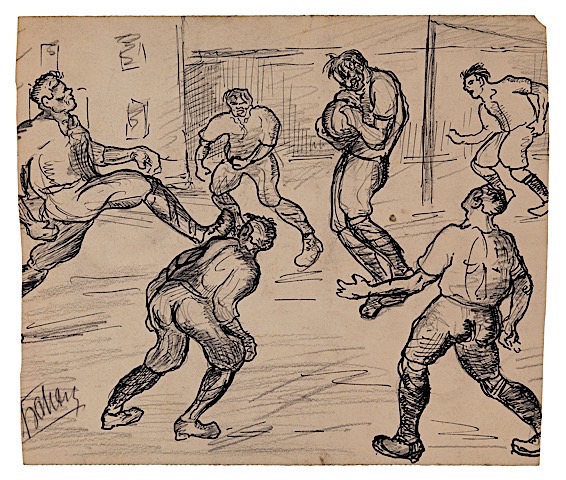
Der Gezeichnete Sven Goldmann Gefördert von Max Liebermann, geschätzt wie Grosz, Dix und Heartfield – doch es bedurfte des 125. Hertha-Geburtstages, um dem Maler Fritz Ascher neue Aufmerksamkeit zu verschaffen. Schwarze Tusche und Grafit auf Papier: „Fußball konnte er also auch malen.“ Verena Veldes Augen huschen über den Ausstellungskatalog, „Leben ist Glühn“, Abbildung 37 auf Seite 202. Eine Zeichnung mit sechs kräftigen Burschen in knielangen Hosen. Einer kommt von links mit kräftigem Spreizschritt herangestürmt, zu spät, der Ball befindet sich schon in den Händen des Torhüters, der drückt ihn zugleich zärtlich und energisch an sich. Konzentriertes Schweigen am anderen Ende des Tisches. So sah Fußball vor 100 Jahren aus – gar nicht so viel anders als heute. „Gefällt mir“, sagt [...]

Sep 17, 2017

2017 – Wiebke Hölzer. Fritz Ascher. Biographisch-Bibliographisches Kirchenlexikon (BBKL), vol. 38. Nordhausen: Verlag Traugott Bautz GmbH. pp. 66-71

2018-12-21T06:00:22-05:00September 17th, 2017|Selected Publications|Comments Off on 2017 – Wiebke Hölzer. Fritz Ascher. Biographisch-Bibliographisches Kirchenlexikon (BBKL), vol. 38. Nordhausen: Verlag Traugott Bautz GmbH. pp. 66-71

Wiebke Hölzer. Fritz Ascher. Biographisch-Bibliographisches Kirchenlexikon (BBKL), vol. 38, Nordhausen: Verlag Traugott Bautz GmbH. pp. 66-71 Download PDF Geboren am 17.10.1893 in Berlin, gestorben am 26.03.1970 in Berlin; expressionistischer Maler und Grafiker, Dichter. Er wuchs als Sohn der jüdisch assimilierten Eltern Hugo Ascher (27.7.1859-18.08.1922) und Minna Luise Ascher, geb. Schneider (17.01.1867-17.10.1938) zusammen mit seinen zwei jüngeren Schwestern Charlotte (08.10.1894-06.12.1978) und Margarete (11.06.1897-15.01.1973) auf. 1899 trat Hugo Ascher mit seinen Kindern aus dem Judentum aus und ließ Fritz 1901 evangelisch taufen. Sein Vater war durch die Entwicklung von künstlichem Zahnschmelz zu Wohlstand gekommen und konnte somit Wohnungen in der Friedrichstraße und der Jägerstraße und später den Bau einer Villa in der Niklasstraße in Zehlendorf finanzieren. 1909 besuchte Ascher — durch das [...]