Rachel Stern2021-02-24T05:40:28-05:00February 24th, 2021|Selected Publications|
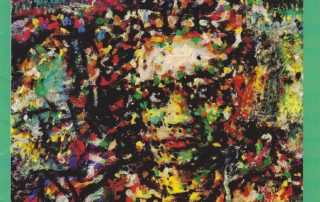
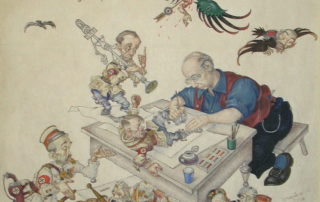
Ascher composed, wrote, drew and painted: Between 1942 and 45 - three long years - he hid from the persecution of the fascists in the basement of a bombed-out house in Berlin-Grunewald. Immobility, loneliness and hunger as well as the fear of betrayal and discovery, torture and death did not leave him during this time. In this situation he found poignant words for his “unpainted pictures”. He conveys both the intensity of his thought processes and his sensitivity for - and his use of - words as well as their nuances and sound patterns. Above all, he demonstrates the indomitable spirit of the artist Fritz Ascher, which no circumstance, regardless of the medium, can prevent from creating with vehement and [...]
Rachel Stern2026-02-11T15:46:56-05:00February 24th, 2021|Selected Publications|
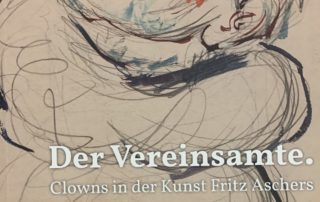
For Fritz Ascher, the ambivalence of the clown as an outsider in society was a central motive. Fritz Ascher found his Bajazzo motif during the First World War, a time of political, societal and social upheaval. In her introduction to this catalog, Rachel Stern traces Ascher's world as well as his artistic development and illuminates the further life of the persecuted and ostracized artist through the horrors of the Nazi regime. In the catalog essays, the authors Jutta Götzmann and Ori Z. Soltes highlight Fritz Ascher's Bajazzo works in a focused way. In addition to Ascher's Bajazzo works, the catalog also includes depictions of landscapes created after 1945, which clearly show the personal and artistic break through experiencing persecution, ostracism [...]
Rachel Stern2022-02-18T07:06:06-05:00February 22nd, 2021|Events, Lectures, Past Events|
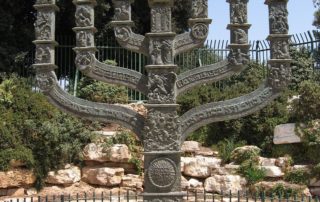
Born 1877 in Dortmund, the sculptor Benno Elkan (1877-1960) first studied painting in Munich and Karlsruhe. At the end of his studies, he turned to sculpture. As a young artist, he spent time in Paris, Rome, and Frankfurt. Elkan’s oeuvre was largely made up of commissions. In the beginning, he mainly created tombs. Medals, portrait busts of well-known personalities, monuments to victims and candelabras follow, partly for the religious (Jewish and Christian) context. Elkan fled persecution by the German Nazi regime to Great Britain in 1934and lived with his family in London until the end of his life. Perhaps the most important work besides the Menorah in Jerusalem (1956) was never built: Memorial to the Defenseless Victims of the Bombing [...]
Rachel Stern2022-02-18T06:31:18-05:00February 17th, 2021|Events, Lectures, Past Events|
During the first four decades of the twentieth century, Polish Jewish artist Arthur Szyk (1894–1951) was best known for his richly detailed book illustrations and magnificent illuminations on Jewish themes. He portrayed the Jews as a heroic nation that had resisted oppression through the ages and eventually triumphed. His Jews were fighters for their own freedom and the freedom of others. Szyk sought to redefine how the Jews viewed themselves and how others viewed them. His works thus challenged the notion that Jewish history was merely one long saga of suffering and, at the same time, refuted the then common antisemitic canard that the Jews were a cowardly people. With the coming to power in Germany of Adolf Hitler [...]
Rachel Stern2022-02-18T07:19:09-05:00January 11th, 2021|Events, Lectures, Past Events|
WATCH THE RECORDING OF THIS EVENT HERE. Visual art during and after the Holocaust, by victims and survivors eloquently contradicts the famous comment by Theodor Adorno that "after the Holocaust to make art is barbaric." On the contrary, it was and is necessary: as part of the record of events as they were transpiring, and as part of the human response to horror--to express anger, to raise questions, to offer healing--in the time after those events. Who creates the art and what kind of art is created? What role does it play in wrestling with the question of what God is and what we humans are? These issues have implications both from within the heart of the Holocaust and from well beyond its particular boundaries. [...]
Rachel Stern2021-02-24T05:46:01-05:00January 10th, 2021|Newsletter|
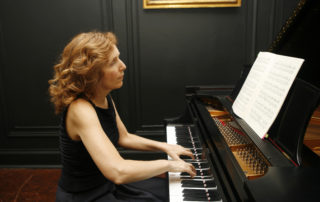
Dear Friends, Please join us, the Museum of Jewish Heritage and the German Consulate General in New York TOMORROW, January 19 at 2:00pm ET for a stirring performance of Carolyn Enger’s Mischlinge Exposé, which will be live streamed from Edmond J. Safra Hall. The performance will be followed by a discussion. Registration link for the livestream HERE. Carolyn Enger is a pianist based in the greater New York City area, with roots reaching back to Breslau, now Wroclaw, Poland. Her “Mischlinge Exposé” brings to light the stories of Mischlinge—a derogatory term used by the Nazis to describe people with both Jewish and Aryan ancestry—like her father and godmother, interwoven [...]
Rachel Stern2021-02-24T05:44:07-05:00January 1st, 2021|Newsletter|
Dear Friends, Thank You For Your Support! When our exhibitions were prematurely closed, we created virtual spaces to get together for lectures and discussions, digital projects and conferences. Thanks to your support, our community grew globally. But this past year has been financially hard for us. If you can, please consider a tax deductible DONATION (https://fritzaschersociety.org/donate/) to the Fritz Ascher Society. The mailing of our new book publication has started. If you are interested in details about ordering a copy, please email fritzaschersociety@gmail.com. (Sorry, US and Canada only) We are very excited about this interdisciplinary volume, which explores the painting of Alice Lok Cahana, a survivor of three [...]
Rachel Stern2022-02-18T07:23:41-05:00December 31st, 2020|Events, Lectures, Past Events|
Join the Museum of Jewish Heritage — A Living Memorial to the Holocaust, the German Consulate General in New York, and the Fritz Ascher Society for Persecuted, Ostracized, and Banned Art for a stirring performance of Enger’s Mischlinge Exposé, Live from Edmond J. Safra Hall™. The performance will be followed by a discussion between Enger and Rachel Stern, Founding Director and CEO of the Fritz Ascher Society. Carolyn Enger is a pianist based in the greater New York City area, with roots reaching back to Breslau, now Wroclaw, Poland. Her Mischlinge Exposé brings to light the stories of Mischlinge—a derogatory term used by the Nazis to describe people with both Jewish and Aryan ancestry—like her [...]
Rachel Stern2020-12-16T12:52:26-05:00December 16th, 2020|Newsletter|
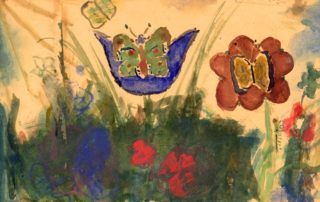
Dear Friends, I HAVE to let you know before 2020 ends: The book is out! We are very excited about this interdisciplinary volume, which explores the painting of Alice Lok Cahana, a survivor of three Holocaust concentration camps; the poetry of her son, Ronnie Cahana; and the photography and award-winning filmmaking of her granddaughter, Kitra Cahana. It places that layered narrative within the context of art, the biology of memory, and the physiological and psychological question of how both creativity and intense trauma can be transmitted from one generation to the next. The book is generously sponsored by the Consulate General of the Federal Republic of Germany in New [...]
Rachel Stern2022-02-18T07:13:15-05:00December 3rd, 2020|Events, Lectures, Past Events|
Oskar Nerlinger (1893-1969) was one of the most important artists of the committed art scene in the Weimar Republic. He was a member of the Association of Proletarian Revolutionary Art (ASSO for short), which was founded in 1928 and belonged to the KPD, which cooperated with the Soviet avant-garde artist group Oktober. At that time there was no conflict between positions of aesthetic modernism and KPD politics. In 1932 the political and artistic avant-garde in the Soviet Union fell apart, with serious consequences for left-wing artists in Germany. Almost at the same time, the Nazi system broke with all forms of modernity. With his idea of art suddenly doubly isolated within his own party, which followed Stalin's art verdict, [...]
Rachel Stern2021-01-11T06:14:12-05:00December 2nd, 2020|Events, Lectures, Past Events|
WATCH THE RECORDING OF THIS EVENT HERE. More information about Janice Biala is available HERE. Lecture featuring Jason Andrew Independent Scholar, Curator and Producer in New York Introduced by Rachel Stern Executive Director of the Fritz Ascher Society in New York Biala (1903-2000) was a Polish born American painter whose career stretched over eight decades and spanned two continents. Through it all, she retained an intimacy in her art rooted in Old World Europe—sensibilities that began with memories of her childhood in a Polish village, shaped by School of Paris painters like Bonnard, Matisse and Braque, inspired by Velázquez and the Spanish Masters, and broadened by the community of loft-living artists in Post World War II Downtown New York. Her [...]
Rachel Stern2020-12-01T06:51:39-05:00November 23rd, 2020|Newsletter|
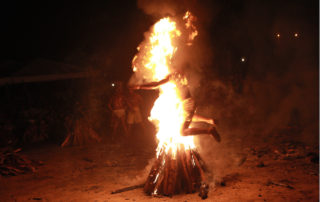
Dear Friends, With Thanksgiving upon us, we announce our last events for 2020: Kitra Cahana, The Cult of Maria Lionza: Fire, 2009. ©Kitra Cahana "A subject passes through me," explains Kitra Cahana. Here, a man who has taken on an Indian spirit and therefore has the power to touch fire, jumps through a fire pit without even flinching on October 12, 2009 during the Baile en Candela - "The Fire Dance" at the entrance to Sorte mountain in Venezuela. On the eve of the 12th of October every year The Fire Dance takes place on the mountain, wherein Maria Lionza practitioners will dress up as Indians take on [...]