Rachel Stern2022-02-18T05:27:54-05:00April 20th, 2021|Events, Lectures, Past Events|
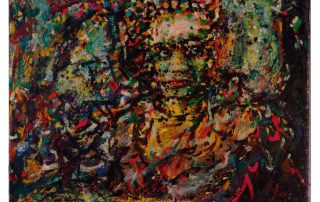
Lecture by Helen Shiner Director/Editor at the Moissey Kogan Catalogue Raisonné of Sculpture & Prints, Oxford (UK) Introduced by Rachel Stern Director and CEO of the Fritz Ascher Society in New York Moissey Kogan (1879-1943) was an innovative, influential sculptor-craftsman and printmaker, whose career straddled the European avant-gardes of the first half of the 20th century. A cosmopolitan Russian Jew, whose work was marked by his interest in Jewish mysticism and theosophical beliefs, Kogan looked to non-European cultures and ancient sources, in common with many of his contemporaries in Munich, Berlin, Amsterdam, and Paris, to root his avant-garde experimentations and revivals of ancient techniques, in what were considered more authentic means of expression. On the day [...]
Rachel Stern2022-02-18T06:37:23-05:00March 4th, 2021|Events, Past Events|
The International Tracing Service (ITS), since 2019 called Arolsen Archives, was established by the Allies in 1948 as a central search and information center. They house the world’s most extensive collection of documents about the victims of National Socialist persecution, including documents from Nazi concentration camps, ghettoes and penal institutions, documents about forced laborers, and documents from the early post-war period about Displaced Persons, mainly Holocaust survivors, former concentration camp prisoners, and forced laborers. People who had fled the sphere of influence of the Soviet Union for political reasons are also included. The archive's holdings consist of 30 million documents in total and belong to UNESCO’s Memory of the World. At this event, Floriane Azoulay (Director) and Giora Zwilling (Deputy [...]
Rachel Stern2022-02-18T06:04:58-05:00March 3rd, 2021|Events, Lectures, Past Events|
The Austrian artist Oskar Kokoschka (1886-1980) achieved world fame with his intense expressionistic portraits and landscapes. Rüdiger Görner, author of the first English-language biography, depicts the artist in all his fascinating and contradictory complexity. He traces Kokoschka’s path from bête noire of the bourgeoisie and a so-called ‘hunger artist’ to a wealthy and cosmopolitan political and critical artist who played a major role in shaping the European art scene of the twentieth century and whose relevance is undiminished to this day. In 1934, Kokoschka left Austria for Prague, and in 1938, when the Czechs began to mobilize for the expected invasion by the German Wehrmacht, Kokoschka fled to the United Kingdom, where he remained during the war. Although he [...]
Rachel Stern2021-02-24T05:40:28-05:00February 24th, 2021|Selected Publications|
Ascher composed, wrote, drew and painted: Between 1942 and 45 - three long years - he hid from the persecution of the fascists in the basement of a bombed-out house in Berlin-Grunewald. Immobility, loneliness and hunger as well as the fear of betrayal and discovery, torture and death did not leave him during this time. In this situation he found poignant words for his “unpainted pictures”. He conveys both the intensity of his thought processes and his sensitivity for - and his use of - words as well as their nuances and sound patterns. Above all, he demonstrates the indomitable spirit of the artist Fritz Ascher, which no circumstance, regardless of the medium, can prevent from creating with vehement and [...]
Rachel Stern2022-02-18T07:06:06-05:00February 22nd, 2021|Events, Lectures, Past Events|
Born 1877 in Dortmund, the sculptor Benno Elkan (1877-1960) first studied painting in Munich and Karlsruhe. At the end of his studies, he turned to sculpture. As a young artist, he spent time in Paris, Rome, and Frankfurt. Elkan’s oeuvre was largely made up of commissions. In the beginning, he mainly created tombs. Medals, portrait busts of well-known personalities, monuments to victims and candelabras follow, partly for the religious (Jewish and Christian) context. Elkan fled persecution by the German Nazi regime to Great Britain in 1934and lived with his family in London until the end of his life. Perhaps the most important work besides the Menorah in Jerusalem (1956) was never built: Memorial to the Defenseless Victims of the Bombing [...]
Rachel Stern2022-02-18T06:31:18-05:00February 17th, 2021|Events, Lectures, Past Events|
During the first four decades of the twentieth century, Polish Jewish artist Arthur Szyk (1894–1951) was best known for his richly detailed book illustrations and magnificent illuminations on Jewish themes. He portrayed the Jews as a heroic nation that had resisted oppression through the ages and eventually triumphed. His Jews were fighters for their own freedom and the freedom of others. Szyk sought to redefine how the Jews viewed themselves and how others viewed them. His works thus challenged the notion that Jewish history was merely one long saga of suffering and, at the same time, refuted the then common antisemitic canard that the Jews were a cowardly people. With the coming to power in Germany of Adolf Hitler [...]
Rachel Stern2022-02-18T07:13:15-05:00December 3rd, 2020|Events, Lectures, Past Events|
Oskar Nerlinger (1893-1969) was one of the most important artists of the committed art scene in the Weimar Republic. He was a member of the Association of Proletarian Revolutionary Art (ASSO for short), which was founded in 1928 and belonged to the KPD, which cooperated with the Soviet avant-garde artist group Oktober. At that time there was no conflict between positions of aesthetic modernism and KPD politics. In 1932 the political and artistic avant-garde in the Soviet Union fell apart, with serious consequences for left-wing artists in Germany. Almost at the same time, the Nazi system broke with all forms of modernity. With his idea of art suddenly doubly isolated within his own party, which followed Stalin's art verdict, [...]
Rachel Stern2021-01-11T06:14:12-05:00December 2nd, 2020|Events, Lectures, Past Events|
WATCH THE RECORDING OF THIS EVENT HERE. More information about Janice Biala is available HERE. Lecture featuring Jason Andrew Independent Scholar, Curator and Producer in New York Introduced by Rachel Stern Executive Director of the Fritz Ascher Society in New York Biala (1903-2000) was a Polish born American painter whose career stretched over eight decades and spanned two continents. Through it all, she retained an intimacy in her art rooted in Old World Europe—sensibilities that began with memories of her childhood in a Polish village, shaped by School of Paris painters like Bonnard, Matisse and Braque, inspired by Velázquez and the Spanish Masters, and broadened by the community of loft-living artists in Post World War II Downtown New York. Her [...]
Rachel Stern2026-09-25T07:13:42-04:00November 18th, 2020|Exhibitions|
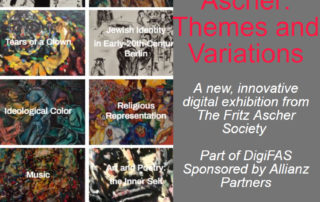
This digital exhibition includes important examples from the oeuvre of the German Jewish Expressionist artist Fritz Ascher (1893-1970). Ascher’s career extended from prior to the First World War until the late 1960s. However, Ascher’s artistic trajectory was interrupted due to persecution under National Socialism, and he spent much of the Second World War in hiding, concealed in a family friend’s basement. Ascher’s work consequently encompasses both the vibrant artistic scene in early-20th-century Germany, as well as the trauma and aesthetic shifts consequent of Ascher’s persecution and deprivations during the twelve years of the Nazi regime. These selected works are representative not only of critical moments in Ascher’s personal and artistic development, but also of key themes that occupied Ascher’s [...]
Rachel Stern2020-11-23T23:33:37-05:00November 1st, 2020|Newsletter|
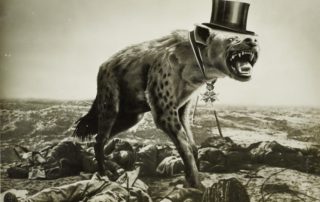
Dear Friends, First of all, IF YOU ARE AN US CITIZEN, PLEASE VOTE! John Heartfield, Krieg und Leichen – Die letzte Hoffnung der Reichen, Montagefotografie für die Arbeiter-Illustrierten-Zeitung, 1932, Nr. 18, Silbergelatineabzug, kaschiert Akademie der Künste, Berlin, Inv.Nr. JH 1955 © The Heartfield Community of Heirs / VG Bild-Kunst, Bonn 2020 This will be an extremely busy month at FAS, starting on November 4, 2020 at 12:00pm ET with Rosa von der Schulenburg’s lecture “About John Heartfield’s Political Engagement and Private Life in London”, which is part of our monthly zoom series “Fight or Flight. stories of artists under repression,” generously funded by Allianz Partners. (SEE EVENT HERE) John [...]
Rachel Stern2020-11-24T20:14:35-05:00October 14th, 2020|Newsletter|
Dear Friends, On October 17 we celebrate Fritz Ascher’s birthday - this year with the launch of DigiFAS - diverse, innovative digital initiatives that provide new ways of engagement with the art and life of artists persecuted by an authoritarian regime. DigiFAS is generously sponsored by Allianz Partners. This launch includes the Society’s first-ever fully digital exhibition “Fritz Ascher: Themes and Variations.” You can explore the exhibition HERE. We have worked on this for months and can’t wait for your reactions! We also invite you to participate in the 2- week digital engagement project “Send in the Clowns,” which explores the clown as a figure between tragedy and comedy, between self- identification [...]
Rachel Stern2020-11-02T20:09:58-05:00September 30th, 2020|Events, Past Events, Send in the Clowns|
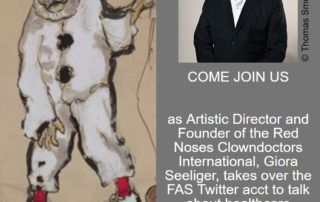
Twitter @Ascher_Society Giora Seeliger, Artistic Director and Founder of Red Noses Clowndoctors International, takes over the FAS Twitter account to answer your burning questions about clowning, the role of a healthcare clown, and anything else that comes to mind! Submit your questions in advance by writing to info@fritzaschersociety.org Part of "Send in the Clowns," an interactive two-week digital initiative, which explores the clown as a figure between tragedy and comedy, between self- identification and stage--a character designed to (literally) mask the performer’s true feelings behind a facade of happiness. “Send in the Clowns” uses the prominence of the “clown” figure in Fritz Ascher’s work as a lens through which to explore the duality of the clown both historically and today. [...]