
Dear Friends,
It is getting chillier outside! Perfect to visit an exhibition or sit down at your computer with a hot cup of coffee or tea, or lunch, and listen to one of our virtual events:
This month, we celebrate two Austrian-born artists: costume designer Ruth Morleyon her 100th birthday (November 19 virtual event), and ceramist Vally Wieselthier, whose work is on view at the Austrian Cultural Forum New York (featured exhibition).
We commemorate the so-called Kristallnacht (The night of broken glass) – the coordinated series of violent anti-Jewish pogroms that took place throughout Nazi Germany, Austria, and the Sudetenland on November 9–10, 1938.
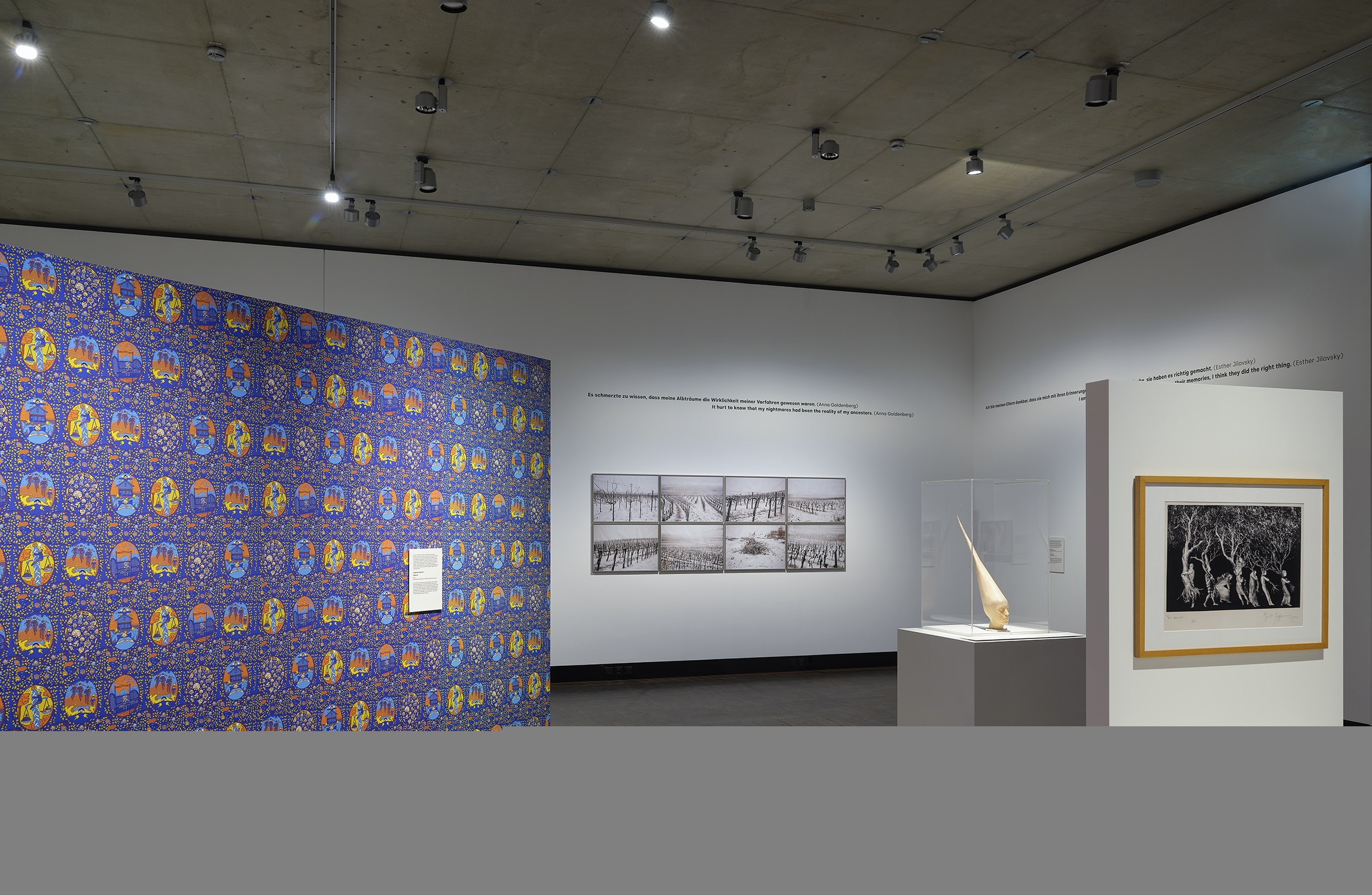
As fewer and fewer Holocaust survivors live among us, we continue to focus on the art and the families they created. The exhibition The Third Generation at the Jewish Museum Munich (featured exhibition) examines trans-generational traumata and the emotional legacy of the survivors. And our November 12 virtual event examines the Holocaust’s profound impact on midcentury American art.
On today’s National Immigrant Day, we invite you to check out the featured artists who were persecuted by the German Nazi regime and able to immigrate to the United States. Explore in our online exhibition IDENTITY, ART AND MIGRATION how their wrenching experiences affected their sense of who they were, and the art they made.
Please share your thoughts, and similar stories if you have them, on our Facebook page or message us on Instagram!
With best wishes,
Rachel Stern
Executive Director
Our next virtual talk explores the ways that American artists confronted the Holocaust in their work during the war and in the decades just after:
WEDNESDAY, November 12, 12:00PM EDT
Confronting the Holocaust
in Midcentury American Art
Presentation by Jennifer McComas, Bloomington, Indiana
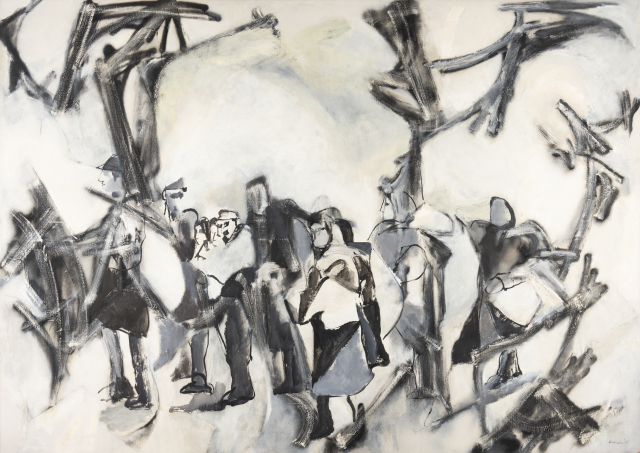
Anna Walinska (American, born England, 1906-1997), Survivors – Exodus, 1958. Oil on canvas, 60 x 84 in. (152.4 x 213.4 cm). Gift of Rosina Rubin, Eskenazi Museum of Art, Indiana University, 2023.29. © Atelier Anna Walinska. Photo: Shanti Knight.
The Holocaust’s profound impact on midcentury American art has been underrecognized and understudied. Jennifer McComas, curator of the current exhibition Remembrance and Renewal: American Artists and the Holocaust, 1940-1970 at Indiana University’s Eskenazi Museum of Art and primary author of the accompanying catalogue, explores the ways that American artists—American-born, immigrants, refugees from Nazi-occupied Europe, and Holocaust survivors—confronted the Holocaust in their work during the war and in the decades just after.
In this talk, McComas will describe how midcentury artists—employing a wide range of aesthetic and stylistic approaches—often alluded to the atrocities indirectly, through symbolism, abstraction, references to Jewish texts and ideas, or simply through titles. Some made private work not meant for sale or exhibition, while others proposed designs for publicly sited Holocaust memorials. Some memorialized family members who had fallen victim to the Nazis, while others grappled with how to visualize more abstract concepts: evil, memory, or renewal. Her talk will provide new insight into modernist art history and Jewish American history.
Jennifer McComas is Curator of European and American Art at the Eskenazi Museum of Art, Indiana University, and is also an affiliated faculty member with the university’s Jewish Studies Program. She established and manages the museum’s World War II-Era Provenance Research Project and is now working on projects exploring experience and identity in the twentieth century. Dr. McComas has lectured widely and contributed to a range of academic publications. Her research has received support from the Henry Luce Foundation, the Terra Foundation for American Art, and the Memorial Foundation for Jewish Culture.
This event is part of the online series Flight or Fight. stories of artists under repression.
It’s her 100th birthday! In our August film screening and discussion, we found out that she survived Nazi persecution on a Kindertransport, but now we devote a virtual event to the artistic legacy of costume designer Ruth Morley:
WEDNESDAY, November 19, 12:00PM EDT
From Vienna to Movies:
Costume Designer Ruth Morley at 100, a birthday commemoration
Presentation by Melissa Hacker and Susan Gammie
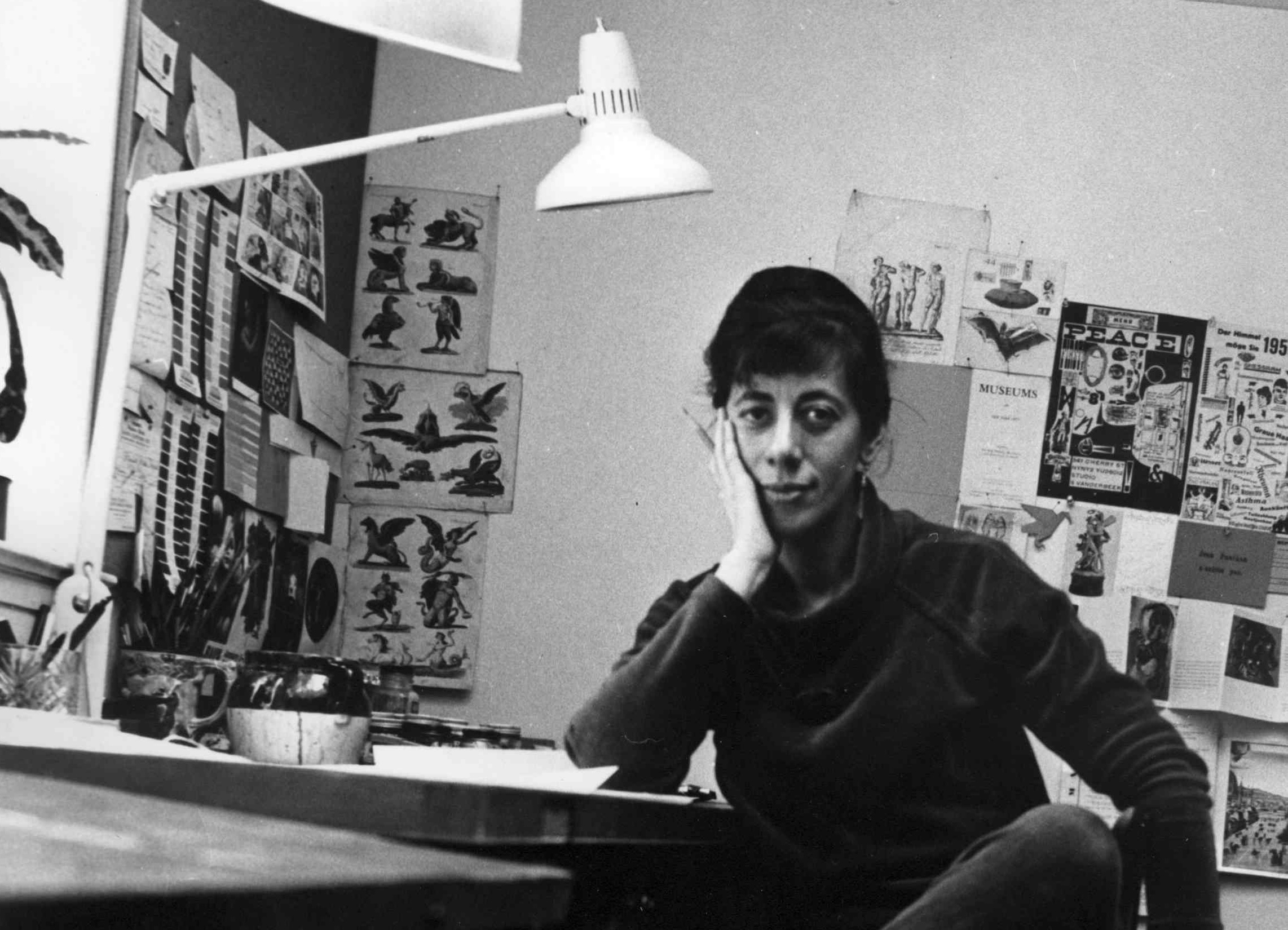
In this virtual event, the life and work of Costume Designer Ruth Morley will be discussed by her daughter Melissa Hacker and Susan Gammie, her assistant, protégé and close friend.
Ruth Morley (1925-1991) fled her childhood home in Vienna on a Kindertransport as an unaccompanied child refugee, arrived in New York City as a teenager, and became a noted costume designer whose career spanned decades and disciplines, including dance, opera, theater, film and television. Her film credits include American classics Tootsie, Annie Hall, Taxi Driver, The Chosen, Kramer vs Kramer and The Hustler; her theater, opera and dance credits include Death of Salesman (with Dustin Hoffman), The Threepenny Opera, Deathtrap, Miracle Worker (stage and film, for the film, she received an Oscar nomination), Billy Budd, the Golem, and many more. Television includes Playing for Time with Vanessa Redgrave and Mussolini with George C Scott and Robert Downey Jr. Over her expansive career of nearly 40 years, she was an inspiration to the many young designers she taught (at New York University and Brandeis) and mentored. While her career was cut short when she died of breast cancer in 1991 at age 65, her contribution to costume design has not ended. In her centennial year, the time is right for commemorating and honoring her legacy.
This event is part of the online series Flight or Fight. stories of artists under repression.
From Berlin to Jerusalem, Paris to Nice: Watch, re-watch and pass on our two most recent virtual events:
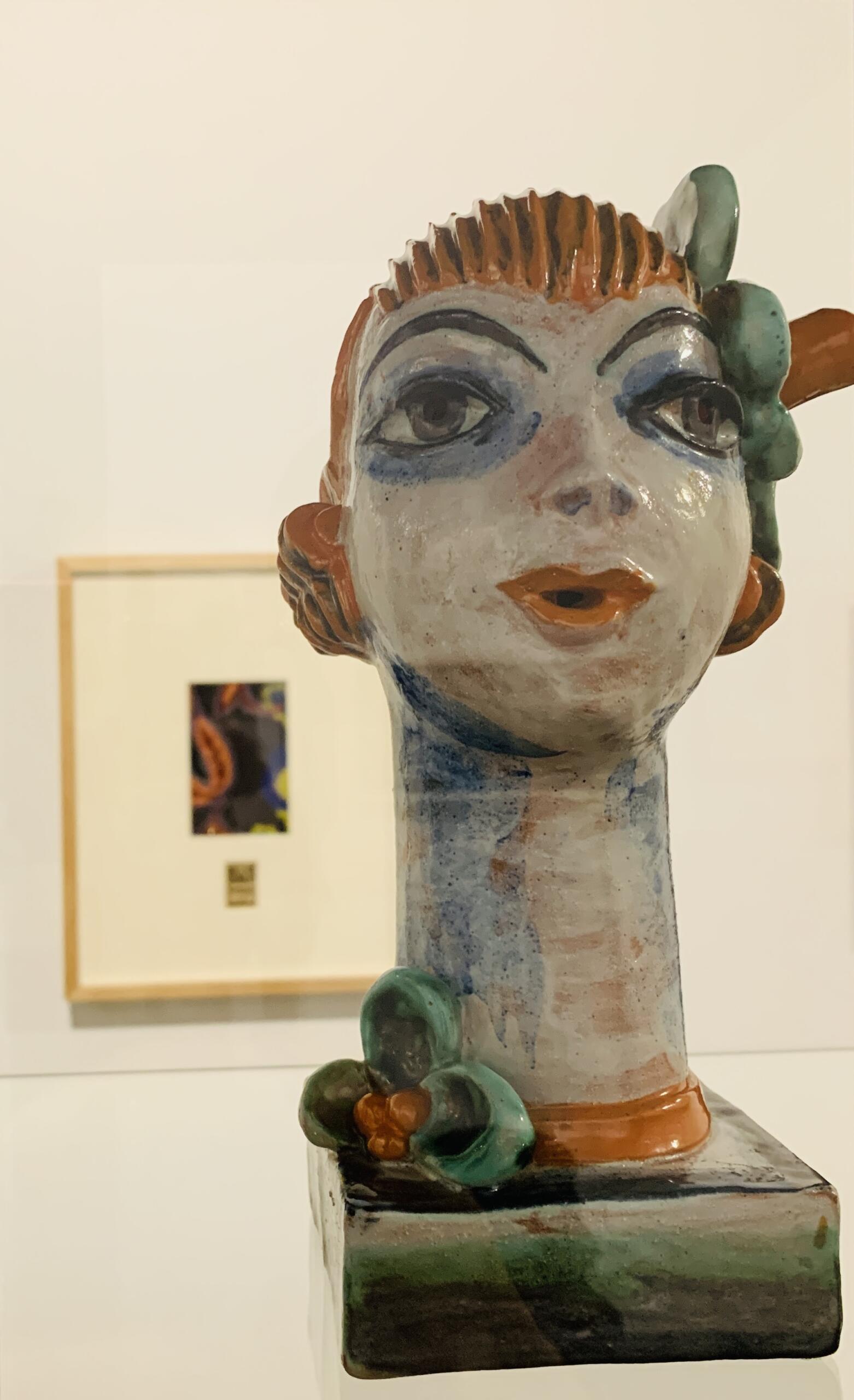
Do you know the Jewish ceramist Vally Wieselthier? Exactly. You can discover her work now in the first international exhibition of her work in New York:
Vally Wieselthier: Sculpting Modernism is on view until February 9, 2026 at the Austrian Cultural Forum New York.
Vienna-born Jewish ceramist Vally Wieselthier (1895-1945) was a pioneering artist of the Wiener Werkstätte and one of the boldest, most irreverent voices in early modern ceramic art. With her wildly expressive figures, Wieselthier broke with tradition and redefined the possibilities of the applied arts in the 20th century.
Beginning in 1928, she also left her mark on American decorative arts through collaborations with major design firms and by participating in various exhibitions, including at the Metropolitan Museum of Art. She moved to Chicago in 1933.
This month, we commemorate so-called Kristallnacht (The night of broken glass) – the coordinated series of violent anti-Jewish pogroms that took place throughout Nazi Germany, Austria, and the Sudetenland on November 9–10, 1938.
An exhibition at the Jewish Museum Munich, created in cooperation with the Jewish Museum Vienna, explores various strategies for dealing with and examining the legacy of the Holocaust. Stay tuned for our virtual event in March with a presentation by one of the exhibition curators!
The Third Generation. The Holocaust in Family Memory is on view until March 1, 2026 at the Jewish Museum Munich.
Eighty years after the Holocaust, the exhibition “The Third Generation” examines transgenerational traumata and the emotional legacy of the survivors. This ties in with the increasingly urgent question: how are we to remember, now that there are virtually no contemporary witnesses, who directly experienced the Holocaust, to be asked? They have passed on their stories, as well as their traumata, to their children and grandchildren.