Dear Friends,
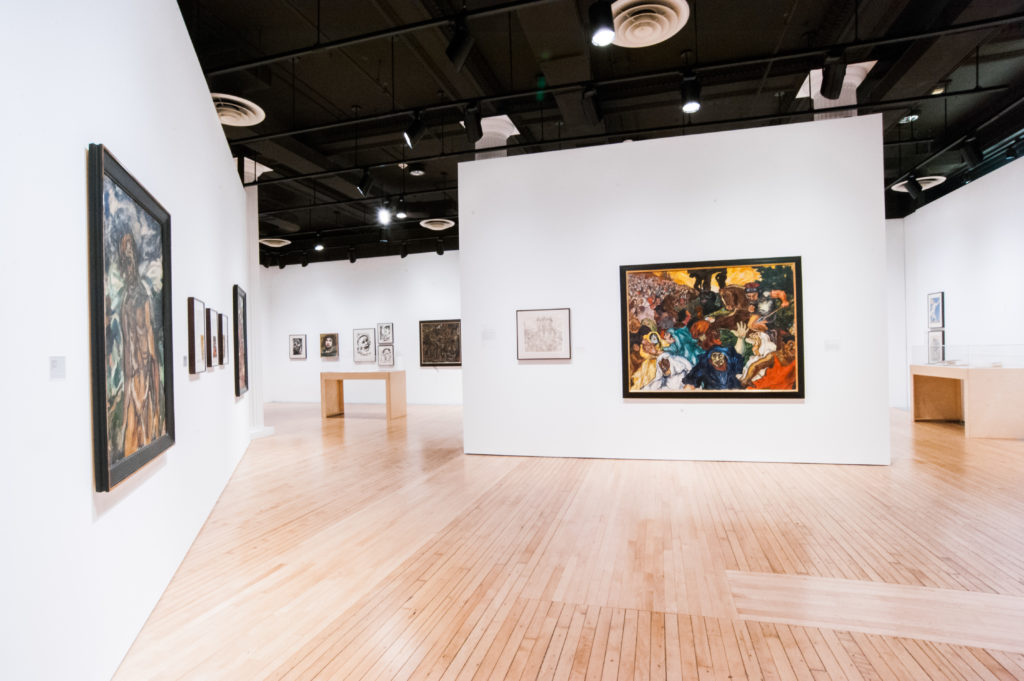
As the snow doesn’t seem to melt here in New York, we slowly move towards the Jewish holiday of Purim. So in our next talk, we will focus on the German-born Israeli artist Jacob Pins who depicted clowns repeatedly. We will explore how he portrayed the clown, a figure between tragedy and comedy, between self-identification and stage, within his larger oeuvre, within the Israeli society and beyond:
Wednesday, February 11, 12:00pm ET online
Jacob Pins (1917-2005): The Art of Laughter and Tears
Presentation by Ori Z Soltes, PhD
Georgetown University, Washington (DC)
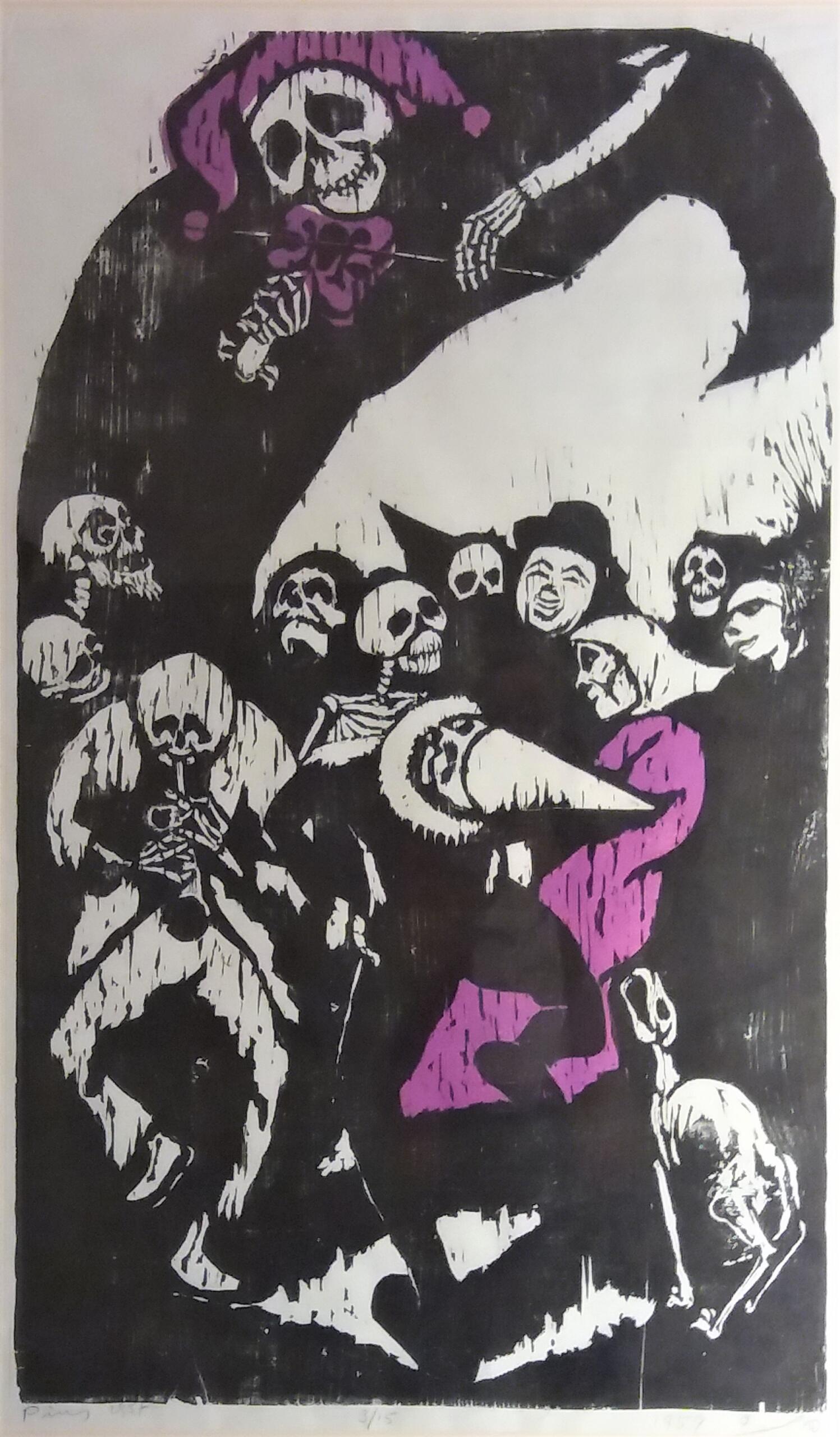
Jacob Pins, Dance of Death, 1957. Color woodcut, 995 x 597 mm. Forum Jacob Pins, Höxter (Germany)
In this image-rich talk, Ori Z. Soltes will explore the pioneering Israeli printmaker Jacob Pins (1917-2005) and the unique place that he holds in the history of Israeli and modern Jewish art. Born into a Jewish family in Höxter, Germany, he immigrated to Palestine in 1936. He studied under German émigré Jacob Steinhardt (1941-45) and became a noted exponent of the woodcut as well as a noted collector. From 1956 to 1977, Pins also taught at Israel’s leading art schools, most notably Bezalel School of Arts and Design in Jerusalem.
Ori Z. Soltes teaches theology, art history, philosophy and political history at Georgetown University. He is former Director of the B’nai B’rith Klutznick National Jewish Museum. As co-founding Director of the Holocaust Art Restitution Project he has spent 25 years focused on the issue of Nazi-plundered art. Soltes has curated over 90 exhibitions, domestically and internationally, and has authored or edited 32 books and scores of articles and exhibition catalogue essays.
This event is part of the online series Flight or Fight. stories of artists under repression.
WEDNESDAY, February 25, 12:00PM ET online
Making and Unmaking Literature
in the Warsaw, Lodz, and Vilna Ghettos
Book talk by Sven-Erik Rose, Davis (CA)
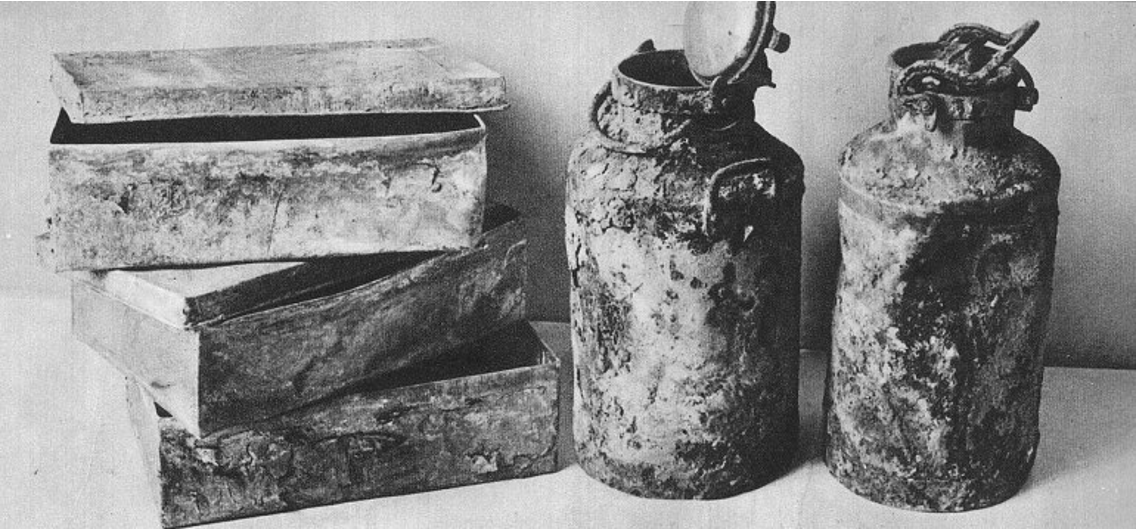
3 (of 9) tins containing the 1st Oyneg Shabes cache, buried Aug. 3, 1942 and unearthed Sept. 1946; and the 2 milk cans containing the 2nd cache, buried Feb. 1943 and recovered December 1950.
In this book talk, author Sven-Erik Rose will speak about his study of literature written by Jewish authors while interned in Nazi ghettos. His book attends to how authors processed their horrific experiences through poetry and prose.
This is the first study devoted to how little known but essential authors grappled with the destitution of ghetto existence by writing within, at the limits of, and against an array of literary scenarios, tropes, plot lines, and generic conventions, including those of nature lyric, modernist interior monologue, the realist social novel, the detective story, and the Gothic horror tale. Contending with starvation, disease, desperate housing conditions and the looming threat of being murdered, inhabitants of Nazi ghettos in Poland nonetheless made them sites of rich Jewish cultural production.
Sven-Erik Rose is a Professor of German and of Comparative Literature, and the Director of the Program in Jewish Studies, at the University of California, Davis. His scholarship and teaching focus on Jewish literature and intellectual history from Germany, France, and Yiddish-speaking Eastern Europe. His first book, Jewish Philosophical Politics in Germany, 1789–1848 (Brandeis University Press, 2014) was awarded the Jordan Schnitzer Book Award from the Association for Jewish Studies in the category of Philosophy and Jewish Thought.
This event is part of the online series Flight or Fight. stories of artists under repression.
We invite you to watch, re-watch and pass on the recordings of our January virtual events:
This month, we again feature an exhibition here in New York, which very closely ties in with our talk about Italian art and artists in Italy during the Fascist regime – you can find the recording of this excellent lecture above:
The Future Was Then: The Changing Face of Fascist Italy is on view until February 22, 2026, at Poster House, New York, NY.
In a fascist movement inspired by art, how does the fascist government influence the artists living in its grasp? This exhibition explores how Benito Mussolini’s government created a broad-reaching culture that grew with and into the Futurist movement to claw into advertising, propaganda, and the very heart of the nation he commanded.
Curator: B.A. Van Sise FRGS

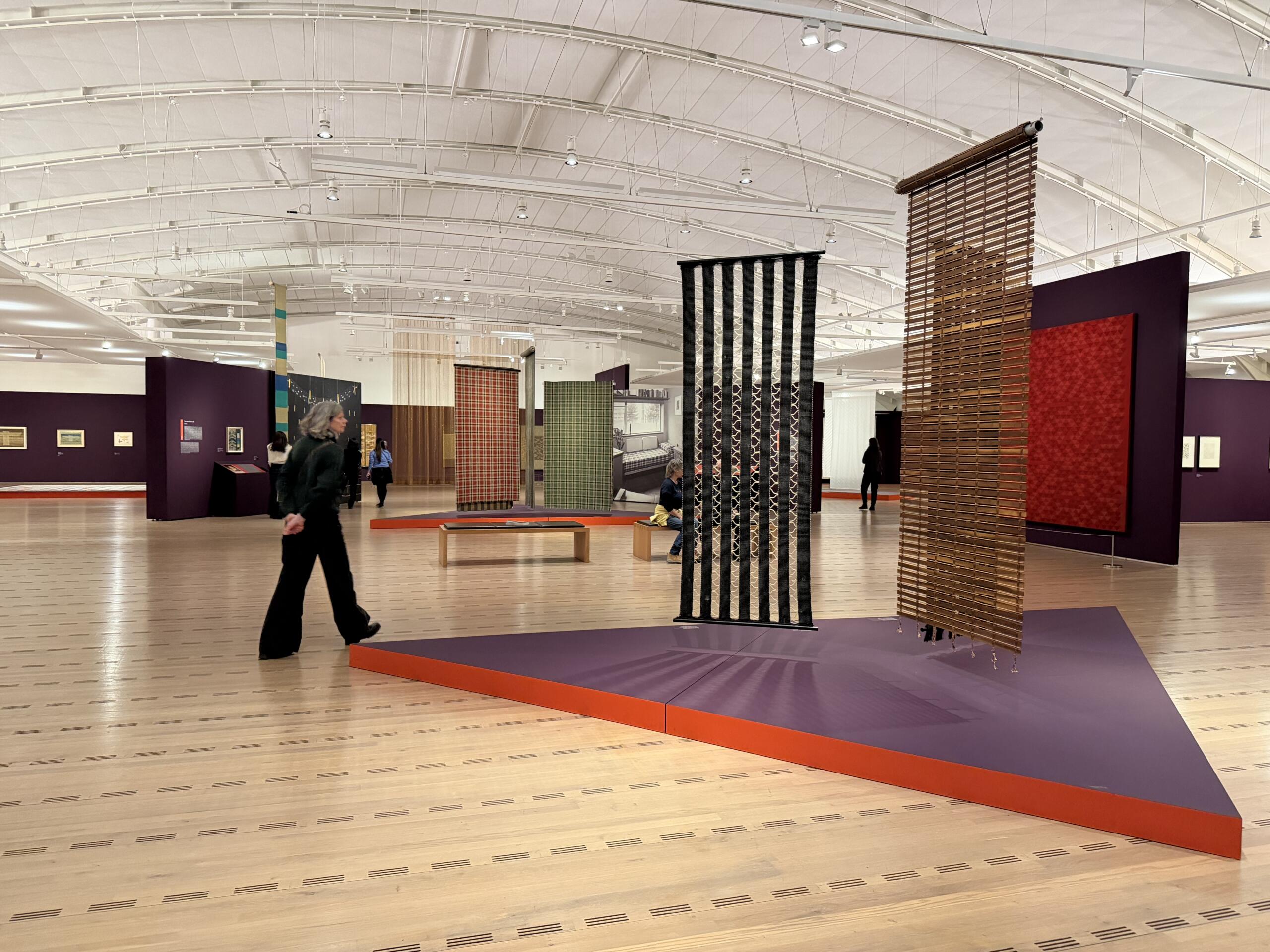
Sometimes we get to see once-in-a-lifetime exhibitions, and the Anni Albers exhibition at Zentrum Paul Klee in Bern is one of them. What a feast to see all these original textiles together! The exhibition will be shown afterwards at the Belvedere in Vienna, 29 April – 16 August 2026.
Born in 1899 in Berlin, Germany, Anni Albers emigrated with her husband Josef Albers to the United States in 1933 to escape persecution by the Nazi regime.
Anni Albers. Constructing Texiles is on view until February 22, 2026 at Zentrum Paul Klee in Bern (Switzerland).
Anni Albers (1899–1994) was one of the leading figures of the 20th century in the field of textile design and textile art. As a Bauhaus student, she developed original fabrics using new materials as architectural elements. She is still considered a pioneer of fibre art today.
The exhibition focuses on her innovative contributions to renowned architectural projects. Fabric designs, textile artworks, prints, and drawings provide an overview of her fascinating work between design and art.
Curators: Fabienne Eggelhöfer and Brenda Danilowitz
You can find out more about Anni Albers in our online exhibition:
Watch the recording of our virtual Anni Albers talk by Laura Muir (Harvard Art Museums) and Ori Z Soltes (Georgetown University):